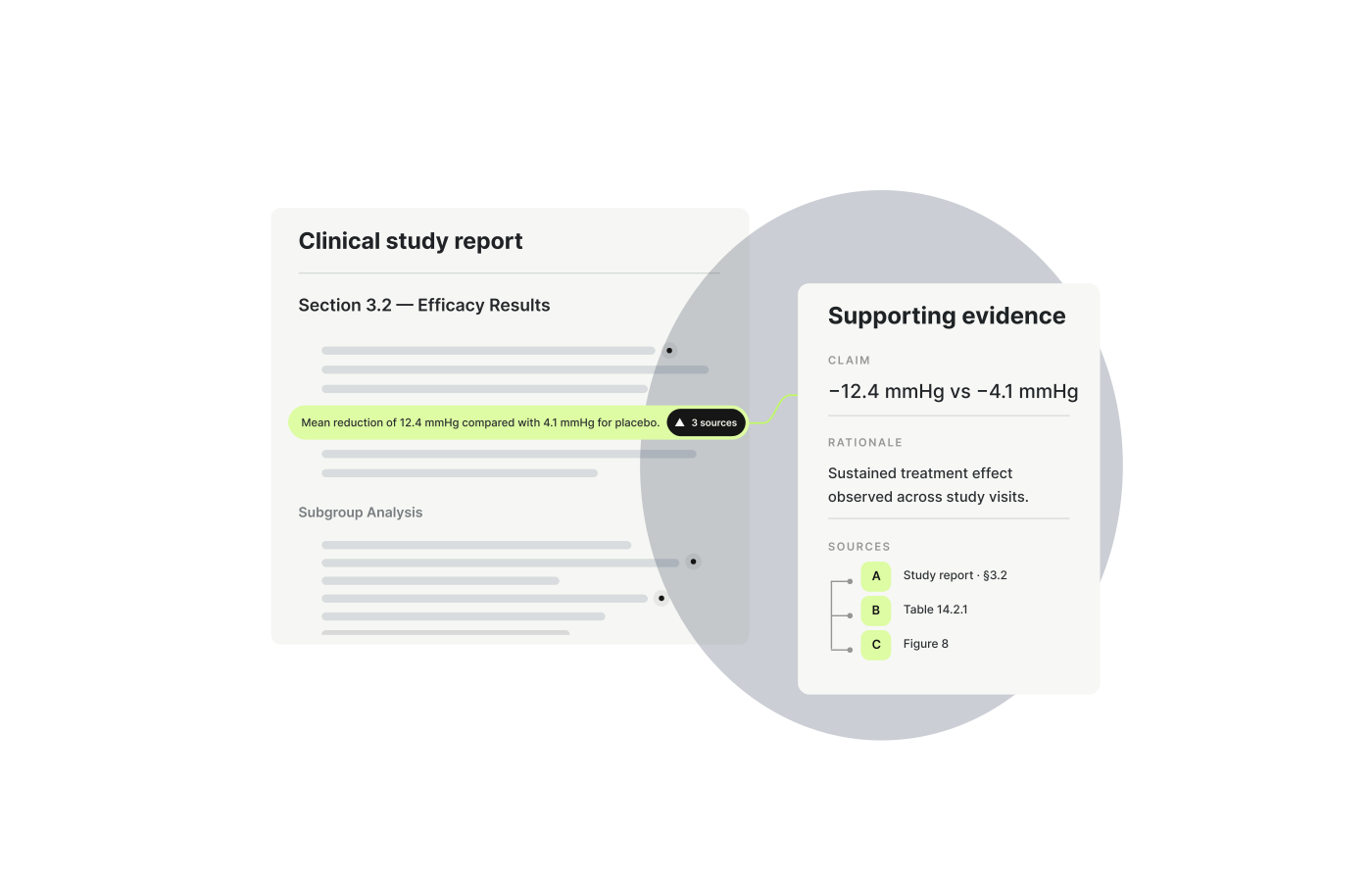
Traceable evidence
Every claim, section, table, figure, and recommendation remains connected to its supporting sources, extracted evidence, and documented rationale.
Biolevate is the evidence-grade AI platform helping life sciences teams scale trusted, auditable AI collaboration across regulated operations.













“Organizations in highly regulated industries need more than powerful AI models. They need governed workflows that support expert decision-making.”

Solutions
Find the right workflow for your industry and development stage.
Pharmaceuticals
Medical devices
Cosmetics
Nutrition
All
Research
Clinical
Regulatory
Market access
Lifecycle
Manufacturing
All
Research
Clinical
Regulatory
Market access
Lifecycle
Manufacturing
Clinical protocol authoring is a high-stakes, cross-functional process constrained by medical writing capacity, evolving study design decisions, and tight development timelines.
Requirements are fragmented across the synopsis, IB, prior protocols, regulatory guidance, endpoint strategy, safety inputs, and statistical assumptions, making consistency and version control difficult.
Biolevate supports human-in-the-loop clinical protocol co-authoring by generating first-pass sections into governed templates while preserving source-linked rationale and reviewer control.
IMPACT
2× faster clinical protocol drafting
View solution
CSR generation remains a manual and time-intensive process. It depends on limited writing resources, creating bottleneck in delivery times.
The data required is fragmented across different sources and teams. Making consolidation, ensuring traceability for the audit and consistently applying the regulatory guidelines are real challenges to face.
IMPACT
Up to 50% less first-draft effort
View solution
Development decisions are increasingly made early, based on strategic hypotheses (positioning, differentiation, claims, access pathway), while the competitive landscape and payer/authority expectations keep evolving.
Teams must translate strategic documents (TPP, clinical strategy, launch plan) into concrete evidence needs, then verify whether existing evidence packs already cover those needs - or whether gaps could block future time-to-market.
Without a structured approach, evidence planning becomes reactive, fragmented, and difficult to prioritize.
IMPACT
3× faster gap mapping
View solution
MSLs operate at the point of decision with HCPs and internal stakeholders, where answers must be immediate, scientifically accurate, and compliant with approved messaging.
Yet the truth is fragmented across asset evidence packs, labels/SmPC, publications, congress materials, and internal FAQs - and it changes as new data emerges.
Traditional medical information workflows are slow to search, hard to keep up to date, and difficult to audit, while generic chatbots lack governance and traceability. Biolevate provides asset-governed medical Q&A that stays grounded in approved evidence with full run-record auditability.
IMPACT
On-demand approved-source answers
View solution
Regulatory volatility creates a continuous compliance burden, where even minor shifts might trigger massive downstream updates to dossiers.
Biolevate turns this reactive cycle into a competitive edge: the platform automates the monitoring of fragmented frameworks, instantly assessing the impact on your portfolio to slash update cycles and prevent market disruptions
IMPACT
80% faster change-to-impact review
View solution
PSUR updates are recurring, high-stakes deliverables under strict timelines, requiring teams to consolidate new safety information and demonstrate ongoing benefit-risk evaluation.
Data and insights are scattered across sources (ICSRs, signal detection outputs, medical literature, risk management documents, previous PSURs), making consolidation, consistency, and traceability difficult.
Identifying what changed since the last reporting period - and updating only what is needed without missing critical impacts - is a major bottleneck.
IMPACT
4× faster PSUR change review
View solution
Scientific literature monitoring is a critical pharmacovigilance activity, but it is increasingly overwhelmed by volume, fragmented sources, and tight timelines for signal evaluation.
Teams must continuously detect potential safety signals, determine whether they are already known or novel, and assess their relevance against the product’s benefit–risk profile and existing safety documentation.
Doing this reliably requires exhaustive reading, consistent classification, and strong traceability — yet manual workflows make prioritization slow and difficult to scale across portfolios.
IMPACT
5× faster signal triage
View solution
PSUR authoring is a recurring, high-stakes deliverable under strict regulatory timelines, requiring teams to consolidate new safety information and demonstrate ongoing benefit–risk evaluation.
Inputs are fragmented across sources (ICSRs, signal detection outputs, medical literature, actions taken, RMP updates, previous PSURs), making consolidation, consistency, and version control difficult.
Ensuring traceability of every conclusion and consistently applying regulatory guidance across cycles is a major bottleneck for PV and medical teams.
IMPACT
50% less drafting effort
View solution
Competitive intelligence in life sciences is increasingly driven by fast-moving regulatory decisions (approvals, label changes, safety communications) and the underlying clinical evidence that supports them.
Teams need to quickly retrieve and screen competitor approvals and clinical activities by indication or molecule, extract what truly matters (endpoints, populations, comparators, safety language), and translate it into actionable strategy.
Because insights must be grounded and comparable to your existing evidence packs, manual workflows become slow, inconsistent, and hard to scale across therapeutic areas.
IMPACT
10× faster competitor decision reviews
View solution
Batch records are the regulatory backbone of life sciences manufacturing, and their quality control remains a complex process prone to human error.
Biolevate bridges this gap with an assisted BRQC solution that assists page-by-page reviews, verifying calculations, signatures, and SOP compliance.
By flagging more mistakes than the human eye, it drastically reduces audit risks and saves massive amounts of time thanks to a guided user path while keeping exhaustive read and traceability.
IMPACT
50% faster QC review
View solution
Protocol authoring remains a high-stakes, time-intensive process, often constrained by limited medical writing capacity and tight study timelines.
Requirements are fragmented across teams (clinical, stats, CQV, safety, regulatory) and sources (IB, prior protocols, guidance), making consolidation, consistency, and version control difficult.
Ensuring traceability of every design choice and aligning with internal standards and regulatory expectations are critical - yet costly to maintain across iterations and amendments.
IMPACT
2× faster protocol drafting
View solution
HTA decisions are the scientific gatekeeper for market access, providing the payer-negotiated insights necessary for pricing, coverage, and commercial success.
These reviews are resource-intensive. When fragmented or delayed, companies can lose crucial market access windows and the ability to proactively influence future appraisals.
Biolevate bridges this gap by enabling teams to scale HTA reviews without compromising accuracy, ensuring a full and defensible rationale at every step.
IMPACT
16× faster decision reviews
View solution
HTA requirements and evidence standards vary by country and evolve quickly, turning market access expansion into a moving target.
Bridging an HTA dossier across markets is no longer just reformatting: it requires re-validating claims, aligning to local methodological expectations, and updating comparators, endpoints, and value narratives.
With evidence scattered across clinical, HEOR, RWE, and prior submissions, maintaining consistency, traceability, and speed across adaptations is a major challenge.
IMPACT
6× faster country adaptations
View solution
HTA dossier authoring is a high-stakes, deadline-driven process that requires turning complex clinical and economic evidence into a clear, payer-ready narrative.
Inputs are fragmented across teams and sources (clinical evidence, SLRs, indirect comparisons, RWE, HEOR models, prior submissions), making consolidation, consistency, and version control difficult.
Every claim must be defendable and traceable to underlying evidence while staying aligned with local HTA expectations - yet dossiers must be updated quickly for new data, new markets, and appraisal questions.
IMPACT
2× faster dossier production
View solution
Health authority responses (e.g., questions, deficiency letters, LoQs, assessment reports) often require rapid, precise updates to regulatory dossiers under strict timelines.
Teams must simultaneously navigate three contexts: (1) the authority’s request and its intent, (2) the current dossier content to be updated, and (3) the applicable regulations/guidelines that define what “compliant” looks like.
Manually reconciling these sources is slow and error-prone, increasing the risk of inconsistent updates, missed impacts, and non-compliance.
IMPACT
3× faster authority response cycles
View solution
Global regulatory shifts create volatile barriers to entry. For Life Sciences, navigating these fragmented frameworks is no longer just a compliance task, it is a market velocity challenge.
Biolevate accelerates expansion: we transform months of manual regulatory mapping into strategic intelligence, allowing teams to bridge dossiers and capture new market opportunities faster
IMPACT
12× faster bridging
View solution
Regulatory dossier authoring is a high-stakes, time-consuming process under constant time pressure, with multiple contributors and frequent late-stage changes.
Whether teams are preparing CTD modules, regional submission packages, variations, renewal dossiers, briefing books, response documents, or other regulated deliverables, content is scattered across source documents (study reports, protocols, CMC, safety updates, literature, prior submissions) and teams, making consolidation, consistency, and version control difficult.
Ensuring traceability of every statement, maintaining alignment across sections and source evidence, and staying compliant with regulatory expectations are essential — yet costly to sustain across iterations, regions, and lifecycle updates.
IMPACT
2× faster regulated section drafting
View solution
In translational research, teams need to move from an omics signature to a defensible biological story that can guide target selection and downstream experiments.
This requires both literature evidence analysis and multi-layer mechanistic validation: parsing full texts, assessing evidence per gene, integrating disease context, pathway/network activity, tissue/cell-type specificity, and testing whether the observed pattern is mechanistically coherent rather than a statistical artifact.
Manual review is slow, inconsistent, and hard to reproduce across programs. Biolevate standardizes the workflow with passage-level traceability, per-gene and signature-level scoring, and KPI-driven coherence analysis to support faster, more confident prioritization.
IMPACT
Per-gene evidence dossiers
View solution
Systematic Literature Reviews (SLRs) and evidence extraction workflows are the scientific backbone of life sciences, providing evidence-based insights for R&D, medical strategy, market access, and patient safety.
They are resource-intensive and difficult to keep up to date, especially when screening criteria, extraction fields, and citation trails are managed manually or outsourced.
Biolevate helps teams scale literature screening and evidence extraction while preserving control, traceability, and repeatable expert-reviewed outputs.
IMPACT
16× faster SLR cycles
View solution
Clinical protocol authoring is a high-stakes, cross-functional process constrained by medical writing capacity, evolving study design decisions, and tight development timelines.
Requirements are fragmented across the synopsis, IB, prior protocols, regulatory guidance, endpoint strategy, safety inputs, and statistical assumptions, making consistency and version control difficult.
Biolevate supports human-in-the-loop clinical protocol co-authoring by generating first-pass sections into governed templates while preserving source-linked rationale and reviewer control.
IMPACT
2× faster clinical protocol drafting
View solution
CSR generation remains a manual and time-intensive process. It depends on limited writing resources, creating bottleneck in delivery times.
The data required is fragmented across different sources and teams. Making consolidation, ensuring traceability for the audit and consistently applying the regulatory guidelines are real challenges to face.
IMPACT
Up to 50% less first-draft effort
View solution
Development decisions are increasingly made early, based on strategic hypotheses (positioning, differentiation, claims, access pathway), while the competitive landscape and payer/authority expectations keep evolving.
Teams must translate strategic documents (TPP, clinical strategy, launch plan) into concrete evidence needs, then verify whether existing evidence packs already cover those needs - or whether gaps could block future time-to-market.
Without a structured approach, evidence planning becomes reactive, fragmented, and difficult to prioritize.
IMPACT
3× faster gap mapping
View solution
MSLs operate at the point of decision with HCPs and internal stakeholders, where answers must be immediate, scientifically accurate, and compliant with approved messaging.
Yet the truth is fragmented across asset evidence packs, labels/SmPC, publications, congress materials, and internal FAQs - and it changes as new data emerges.
Traditional medical information workflows are slow to search, hard to keep up to date, and difficult to audit, while generic chatbots lack governance and traceability. Biolevate provides asset-governed medical Q&A that stays grounded in approved evidence with full run-record auditability.
IMPACT
On-demand approved-source answers
View solution
Regulatory volatility creates a continuous compliance burden, where even minor shifts might trigger massive downstream updates to dossiers.
Biolevate turns this reactive cycle into a competitive edge: the platform automates the monitoring of fragmented frameworks, instantly assessing the impact on your portfolio to slash update cycles and prevent market disruptions
IMPACT
80% faster change-to-impact review
View solution
PSUR updates are recurring, high-stakes deliverables under strict timelines, requiring teams to consolidate new safety information and demonstrate ongoing benefit-risk evaluation.
Data and insights are scattered across sources (ICSRs, signal detection outputs, medical literature, risk management documents, previous PSURs), making consolidation, consistency, and traceability difficult.
Identifying what changed since the last reporting period - and updating only what is needed without missing critical impacts - is a major bottleneck.
IMPACT
4× faster PSUR change review
View solution
Scientific literature monitoring is a critical pharmacovigilance activity, but it is increasingly overwhelmed by volume, fragmented sources, and tight timelines for signal evaluation.
Teams must continuously detect potential safety signals, determine whether they are already known or novel, and assess their relevance against the product’s benefit–risk profile and existing safety documentation.
Doing this reliably requires exhaustive reading, consistent classification, and strong traceability — yet manual workflows make prioritization slow and difficult to scale across portfolios.
IMPACT
5× faster signal triage
View solution
PSUR authoring is a recurring, high-stakes deliverable under strict regulatory timelines, requiring teams to consolidate new safety information and demonstrate ongoing benefit–risk evaluation.
Inputs are fragmented across sources (ICSRs, signal detection outputs, medical literature, actions taken, RMP updates, previous PSURs), making consolidation, consistency, and version control difficult.
Ensuring traceability of every conclusion and consistently applying regulatory guidance across cycles is a major bottleneck for PV and medical teams.
IMPACT
50% less drafting effort
View solution
Competitive intelligence in life sciences is increasingly driven by fast-moving regulatory decisions (approvals, label changes, safety communications) and the underlying clinical evidence that supports them.
Teams need to quickly retrieve and screen competitor approvals and clinical activities by indication or molecule, extract what truly matters (endpoints, populations, comparators, safety language), and translate it into actionable strategy.
Because insights must be grounded and comparable to your existing evidence packs, manual workflows become slow, inconsistent, and hard to scale across therapeutic areas.
IMPACT
10× faster competitor decision reviews
View solution
Batch records are the regulatory backbone of life sciences manufacturing, and their quality control remains a complex process prone to human error.
Biolevate bridges this gap with an assisted BRQC solution that assists page-by-page reviews, verifying calculations, signatures, and SOP compliance.
By flagging more mistakes than the human eye, it drastically reduces audit risks and saves massive amounts of time thanks to a guided user path while keeping exhaustive read and traceability.
IMPACT
50% faster QC review
View solution
Protocol authoring remains a high-stakes, time-intensive process, often constrained by limited medical writing capacity and tight study timelines.
Requirements are fragmented across teams (clinical, stats, CQV, safety, regulatory) and sources (IB, prior protocols, guidance), making consolidation, consistency, and version control difficult.
Ensuring traceability of every design choice and aligning with internal standards and regulatory expectations are critical - yet costly to maintain across iterations and amendments.
IMPACT
2× faster protocol drafting
View solution
HTA decisions are the scientific gatekeeper for market access, providing the payer-negotiated insights necessary for pricing, coverage, and commercial success.
These reviews are resource-intensive. When fragmented or delayed, companies can lose crucial market access windows and the ability to proactively influence future appraisals.
Biolevate bridges this gap by enabling teams to scale HTA reviews without compromising accuracy, ensuring a full and defensible rationale at every step.
IMPACT
16× faster decision reviews
View solution
HTA requirements and evidence standards vary by country and evolve quickly, turning market access expansion into a moving target.
Bridging an HTA dossier across markets is no longer just reformatting: it requires re-validating claims, aligning to local methodological expectations, and updating comparators, endpoints, and value narratives.
With evidence scattered across clinical, HEOR, RWE, and prior submissions, maintaining consistency, traceability, and speed across adaptations is a major challenge.
IMPACT
6× faster country adaptations
View solution
HTA dossier authoring is a high-stakes, deadline-driven process that requires turning complex clinical and economic evidence into a clear, payer-ready narrative.
Inputs are fragmented across teams and sources (clinical evidence, SLRs, indirect comparisons, RWE, HEOR models, prior submissions), making consolidation, consistency, and version control difficult.
Every claim must be defendable and traceable to underlying evidence while staying aligned with local HTA expectations - yet dossiers must be updated quickly for new data, new markets, and appraisal questions.
IMPACT
2× faster dossier production
View solution
Health authority responses (e.g., questions, deficiency letters, LoQs, assessment reports) often require rapid, precise updates to regulatory dossiers under strict timelines.
Teams must simultaneously navigate three contexts: (1) the authority’s request and its intent, (2) the current dossier content to be updated, and (3) the applicable regulations/guidelines that define what “compliant” looks like.
Manually reconciling these sources is slow and error-prone, increasing the risk of inconsistent updates, missed impacts, and non-compliance.
IMPACT
3× faster authority response cycles
View solution
Global regulatory shifts create volatile barriers to entry. For Life Sciences, navigating these fragmented frameworks is no longer just a compliance task, it is a market velocity challenge.
Biolevate accelerates expansion: we transform months of manual regulatory mapping into strategic intelligence, allowing teams to bridge dossiers and capture new market opportunities faster
IMPACT
12× faster bridging
View solution
Regulatory dossier authoring is a high-stakes, time-consuming process under constant time pressure, with multiple contributors and frequent late-stage changes.
Whether teams are preparing CTD modules, regional submission packages, variations, renewal dossiers, briefing books, response documents, or other regulated deliverables, content is scattered across source documents (study reports, protocols, CMC, safety updates, literature, prior submissions) and teams, making consolidation, consistency, and version control difficult.
Ensuring traceability of every statement, maintaining alignment across sections and source evidence, and staying compliant with regulatory expectations are essential — yet costly to sustain across iterations, regions, and lifecycle updates.
IMPACT
2× faster regulated section drafting
View solution
In translational research, teams need to move from an omics signature to a defensible biological story that can guide target selection and downstream experiments.
This requires both literature evidence analysis and multi-layer mechanistic validation: parsing full texts, assessing evidence per gene, integrating disease context, pathway/network activity, tissue/cell-type specificity, and testing whether the observed pattern is mechanistically coherent rather than a statistical artifact.
Manual review is slow, inconsistent, and hard to reproduce across programs. Biolevate standardizes the workflow with passage-level traceability, per-gene and signature-level scoring, and KPI-driven coherence analysis to support faster, more confident prioritization.
IMPACT
Per-gene evidence dossiers
View solution
Systematic Literature Reviews (SLRs) and evidence extraction workflows are the scientific backbone of life sciences, providing evidence-based insights for R&D, medical strategy, market access, and patient safety.
They are resource-intensive and difficult to keep up to date, especially when screening criteria, extraction fields, and citation trails are managed manually or outsourced.
Biolevate helps teams scale literature screening and evidence extraction while preserving control, traceability, and repeatable expert-reviewed outputs.
IMPACT
16× faster SLR cycles
View solution
Clinical protocol authoring is a high-stakes, cross-functional process constrained by medical writing capacity, evolving study design decisions, and tight development timelines.
Requirements are fragmented across the synopsis, IB, prior protocols, regulatory guidance, endpoint strategy, safety inputs, and statistical assumptions, making consistency and version control difficult.
Biolevate supports human-in-the-loop clinical protocol co-authoring by generating first-pass sections into governed templates while preserving source-linked rationale and reviewer control.
IMPACT
2× faster clinical protocol drafting
View solution
CSR generation remains a manual and time-intensive process. It depends on limited writing resources, creating bottleneck in delivery times.
The data required is fragmented across different sources and teams. Making consolidation, ensuring traceability for the audit and consistently applying the regulatory guidelines are real challenges to face.
IMPACT
Up to 50% less first-draft effort
View solution
Development decisions are increasingly made early, based on strategic hypotheses (positioning, differentiation, claims, access pathway), while the competitive landscape and payer/authority expectations keep evolving.
Teams must translate strategic documents (TPP, clinical strategy, launch plan) into concrete evidence needs, then verify whether existing evidence packs already cover those needs - or whether gaps could block future time-to-market.
Without a structured approach, evidence planning becomes reactive, fragmented, and difficult to prioritize.
IMPACT
3× faster gap mapping
View solution
MSLs operate at the point of decision with HCPs and internal stakeholders, where answers must be immediate, scientifically accurate, and compliant with approved messaging.
Yet the truth is fragmented across asset evidence packs, labels/SmPC, publications, congress materials, and internal FAQs - and it changes as new data emerges.
Traditional medical information workflows are slow to search, hard to keep up to date, and difficult to audit, while generic chatbots lack governance and traceability. Biolevate provides asset-governed medical Q&A that stays grounded in approved evidence with full run-record auditability.
IMPACT
On-demand approved-source answers
View solution
Regulatory volatility creates a continuous compliance burden, where even minor shifts might trigger massive downstream updates to dossiers.
Biolevate turns this reactive cycle into a competitive edge: the platform automates the monitoring of fragmented frameworks, instantly assessing the impact on your portfolio to slash update cycles and prevent market disruptions
IMPACT
80% faster change-to-impact review
View solution
PSUR updates are recurring, high-stakes deliverables under strict timelines, requiring teams to consolidate new safety information and demonstrate ongoing benefit-risk evaluation.
Data and insights are scattered across sources (ICSRs, signal detection outputs, medical literature, risk management documents, previous PSURs), making consolidation, consistency, and traceability difficult.
Identifying what changed since the last reporting period - and updating only what is needed without missing critical impacts - is a major bottleneck.
IMPACT
4× faster PSUR change review
View solution
Scientific literature monitoring is a critical pharmacovigilance activity, but it is increasingly overwhelmed by volume, fragmented sources, and tight timelines for signal evaluation.
Teams must continuously detect potential safety signals, determine whether they are already known or novel, and assess their relevance against the product’s benefit–risk profile and existing safety documentation.
Doing this reliably requires exhaustive reading, consistent classification, and strong traceability — yet manual workflows make prioritization slow and difficult to scale across portfolios.
IMPACT
5× faster signal triage
View solution
PSUR authoring is a recurring, high-stakes deliverable under strict regulatory timelines, requiring teams to consolidate new safety information and demonstrate ongoing benefit–risk evaluation.
Inputs are fragmented across sources (ICSRs, signal detection outputs, medical literature, actions taken, RMP updates, previous PSURs), making consolidation, consistency, and version control difficult.
Ensuring traceability of every conclusion and consistently applying regulatory guidance across cycles is a major bottleneck for PV and medical teams.
IMPACT
50% less drafting effort
View solution
Competitive intelligence in life sciences is increasingly driven by fast-moving regulatory decisions (approvals, label changes, safety communications) and the underlying clinical evidence that supports them.
Teams need to quickly retrieve and screen competitor approvals and clinical activities by indication or molecule, extract what truly matters (endpoints, populations, comparators, safety language), and translate it into actionable strategy.
Because insights must be grounded and comparable to your existing evidence packs, manual workflows become slow, inconsistent, and hard to scale across therapeutic areas.
IMPACT
10× faster competitor decision reviews
View solution
Batch records are the regulatory backbone of life sciences manufacturing, and their quality control remains a complex process prone to human error.
Biolevate bridges this gap with an assisted BRQC solution that assists page-by-page reviews, verifying calculations, signatures, and SOP compliance.
By flagging more mistakes than the human eye, it drastically reduces audit risks and saves massive amounts of time thanks to a guided user path while keeping exhaustive read and traceability.
IMPACT
50% faster QC review
View solution
Protocol authoring remains a high-stakes, time-intensive process, often constrained by limited medical writing capacity and tight study timelines.
Requirements are fragmented across teams (clinical, stats, CQV, safety, regulatory) and sources (IB, prior protocols, guidance), making consolidation, consistency, and version control difficult.
Ensuring traceability of every design choice and aligning with internal standards and regulatory expectations are critical - yet costly to maintain across iterations and amendments.
IMPACT
2× faster protocol drafting
View solution
HTA decisions are the scientific gatekeeper for market access, providing the payer-negotiated insights necessary for pricing, coverage, and commercial success.
These reviews are resource-intensive. When fragmented or delayed, companies can lose crucial market access windows and the ability to proactively influence future appraisals.
Biolevate bridges this gap by enabling teams to scale HTA reviews without compromising accuracy, ensuring a full and defensible rationale at every step.
IMPACT
16× faster decision reviews
View solution
HTA requirements and evidence standards vary by country and evolve quickly, turning market access expansion into a moving target.
Bridging an HTA dossier across markets is no longer just reformatting: it requires re-validating claims, aligning to local methodological expectations, and updating comparators, endpoints, and value narratives.
With evidence scattered across clinical, HEOR, RWE, and prior submissions, maintaining consistency, traceability, and speed across adaptations is a major challenge.
IMPACT
6× faster country adaptations
View solution
HTA dossier authoring is a high-stakes, deadline-driven process that requires turning complex clinical and economic evidence into a clear, payer-ready narrative.
Inputs are fragmented across teams and sources (clinical evidence, SLRs, indirect comparisons, RWE, HEOR models, prior submissions), making consolidation, consistency, and version control difficult.
Every claim must be defendable and traceable to underlying evidence while staying aligned with local HTA expectations - yet dossiers must be updated quickly for new data, new markets, and appraisal questions.
IMPACT
2× faster dossier production
View solution
Health authority responses (e.g., questions, deficiency letters, LoQs, assessment reports) often require rapid, precise updates to regulatory dossiers under strict timelines.
Teams must simultaneously navigate three contexts: (1) the authority’s request and its intent, (2) the current dossier content to be updated, and (3) the applicable regulations/guidelines that define what “compliant” looks like.
Manually reconciling these sources is slow and error-prone, increasing the risk of inconsistent updates, missed impacts, and non-compliance.
IMPACT
3× faster authority response cycles
View solution
Global regulatory shifts create volatile barriers to entry. For Life Sciences, navigating these fragmented frameworks is no longer just a compliance task, it is a market velocity challenge.
Biolevate accelerates expansion: we transform months of manual regulatory mapping into strategic intelligence, allowing teams to bridge dossiers and capture new market opportunities faster
IMPACT
12× faster bridging
View solution
Regulatory dossier authoring is a high-stakes, time-consuming process under constant time pressure, with multiple contributors and frequent late-stage changes.
Whether teams are preparing CTD modules, regional submission packages, variations, renewal dossiers, briefing books, response documents, or other regulated deliverables, content is scattered across source documents (study reports, protocols, CMC, safety updates, literature, prior submissions) and teams, making consolidation, consistency, and version control difficult.
Ensuring traceability of every statement, maintaining alignment across sections and source evidence, and staying compliant with regulatory expectations are essential — yet costly to sustain across iterations, regions, and lifecycle updates.
IMPACT
2× faster regulated section drafting
View solution
In translational research, teams need to move from an omics signature to a defensible biological story that can guide target selection and downstream experiments.
This requires both literature evidence analysis and multi-layer mechanistic validation: parsing full texts, assessing evidence per gene, integrating disease context, pathway/network activity, tissue/cell-type specificity, and testing whether the observed pattern is mechanistically coherent rather than a statistical artifact.
Manual review is slow, inconsistent, and hard to reproduce across programs. Biolevate standardizes the workflow with passage-level traceability, per-gene and signature-level scoring, and KPI-driven coherence analysis to support faster, more confident prioritization.
IMPACT
Per-gene evidence dossiers
View solution
Systematic Literature Reviews (SLRs) and evidence extraction workflows are the scientific backbone of life sciences, providing evidence-based insights for R&D, medical strategy, market access, and patient safety.
They are resource-intensive and difficult to keep up to date, especially when screening criteria, extraction fields, and citation trails are managed manually or outsourced.
Biolevate helps teams scale literature screening and evidence extraction while preserving control, traceability, and repeatable expert-reviewed outputs.
IMPACT
16× faster SLR cycles
View solution
Clinical protocol authoring is a high-stakes, cross-functional process constrained by medical writing capacity, evolving study design decisions, and tight development timelines.
Requirements are fragmented across the synopsis, IB, prior protocols, regulatory guidance, endpoint strategy, safety inputs, and statistical assumptions, making consistency and version control difficult.
Biolevate supports human-in-the-loop clinical protocol co-authoring by generating first-pass sections into governed templates while preserving source-linked rationale and reviewer control.
IMPACT
2× faster clinical protocol drafting
View solution
CSR generation remains a manual and time-intensive process. It depends on limited writing resources, creating bottleneck in delivery times.
The data required is fragmented across different sources and teams. Making consolidation, ensuring traceability for the audit and consistently applying the regulatory guidelines are real challenges to face.
IMPACT
Up to 50% less first-draft effort
View solution
Development decisions are increasingly made early, based on strategic hypotheses (positioning, differentiation, claims, access pathway), while the competitive landscape and payer/authority expectations keep evolving.
Teams must translate strategic documents (TPP, clinical strategy, launch plan) into concrete evidence needs, then verify whether existing evidence packs already cover those needs - or whether gaps could block future time-to-market.
Without a structured approach, evidence planning becomes reactive, fragmented, and difficult to prioritize.
IMPACT
3× faster gap mapping
View solution
MSLs operate at the point of decision with HCPs and internal stakeholders, where answers must be immediate, scientifically accurate, and compliant with approved messaging.
Yet the truth is fragmented across asset evidence packs, labels/SmPC, publications, congress materials, and internal FAQs - and it changes as new data emerges.
Traditional medical information workflows are slow to search, hard to keep up to date, and difficult to audit, while generic chatbots lack governance and traceability. Biolevate provides asset-governed medical Q&A that stays grounded in approved evidence with full run-record auditability.
IMPACT
On-demand approved-source answers
View solution
Regulatory volatility creates a continuous compliance burden, where even minor shifts might trigger massive downstream updates to dossiers.
Biolevate turns this reactive cycle into a competitive edge: the platform automates the monitoring of fragmented frameworks, instantly assessing the impact on your portfolio to slash update cycles and prevent market disruptions
IMPACT
80% faster change-to-impact review
View solution
PSUR updates are recurring, high-stakes deliverables under strict timelines, requiring teams to consolidate new safety information and demonstrate ongoing benefit-risk evaluation.
Data and insights are scattered across sources (ICSRs, signal detection outputs, medical literature, risk management documents, previous PSURs), making consolidation, consistency, and traceability difficult.
Identifying what changed since the last reporting period - and updating only what is needed without missing critical impacts - is a major bottleneck.
IMPACT
4× faster PSUR change review
View solution
Scientific literature monitoring is a critical pharmacovigilance activity, but it is increasingly overwhelmed by volume, fragmented sources, and tight timelines for signal evaluation.
Teams must continuously detect potential safety signals, determine whether they are already known or novel, and assess their relevance against the product’s benefit–risk profile and existing safety documentation.
Doing this reliably requires exhaustive reading, consistent classification, and strong traceability — yet manual workflows make prioritization slow and difficult to scale across portfolios.
IMPACT
5× faster signal triage
View solution
PSUR authoring is a recurring, high-stakes deliverable under strict regulatory timelines, requiring teams to consolidate new safety information and demonstrate ongoing benefit–risk evaluation.
Inputs are fragmented across sources (ICSRs, signal detection outputs, medical literature, actions taken, RMP updates, previous PSURs), making consolidation, consistency, and version control difficult.
Ensuring traceability of every conclusion and consistently applying regulatory guidance across cycles is a major bottleneck for PV and medical teams.
IMPACT
50% less drafting effort
View solution
Competitive intelligence in life sciences is increasingly driven by fast-moving regulatory decisions (approvals, label changes, safety communications) and the underlying clinical evidence that supports them.
Teams need to quickly retrieve and screen competitor approvals and clinical activities by indication or molecule, extract what truly matters (endpoints, populations, comparators, safety language), and translate it into actionable strategy.
Because insights must be grounded and comparable to your existing evidence packs, manual workflows become slow, inconsistent, and hard to scale across therapeutic areas.
IMPACT
10× faster competitor decision reviews
View solution
Batch records are the regulatory backbone of life sciences manufacturing, and their quality control remains a complex process prone to human error.
Biolevate bridges this gap with an assisted BRQC solution that assists page-by-page reviews, verifying calculations, signatures, and SOP compliance.
By flagging more mistakes than the human eye, it drastically reduces audit risks and saves massive amounts of time thanks to a guided user path while keeping exhaustive read and traceability.
IMPACT
50% faster QC review
View solution
Protocol authoring remains a high-stakes, time-intensive process, often constrained by limited medical writing capacity and tight study timelines.
Requirements are fragmented across teams (clinical, stats, CQV, safety, regulatory) and sources (IB, prior protocols, guidance), making consolidation, consistency, and version control difficult.
Ensuring traceability of every design choice and aligning with internal standards and regulatory expectations are critical - yet costly to maintain across iterations and amendments.
IMPACT
2× faster protocol drafting
View solution
HTA decisions are the scientific gatekeeper for market access, providing the payer-negotiated insights necessary for pricing, coverage, and commercial success.
These reviews are resource-intensive. When fragmented or delayed, companies can lose crucial market access windows and the ability to proactively influence future appraisals.
Biolevate bridges this gap by enabling teams to scale HTA reviews without compromising accuracy, ensuring a full and defensible rationale at every step.
IMPACT
16× faster decision reviews
View solution
HTA requirements and evidence standards vary by country and evolve quickly, turning market access expansion into a moving target.
Bridging an HTA dossier across markets is no longer just reformatting: it requires re-validating claims, aligning to local methodological expectations, and updating comparators, endpoints, and value narratives.
With evidence scattered across clinical, HEOR, RWE, and prior submissions, maintaining consistency, traceability, and speed across adaptations is a major challenge.
IMPACT
6× faster country adaptations
View solution
HTA dossier authoring is a high-stakes, deadline-driven process that requires turning complex clinical and economic evidence into a clear, payer-ready narrative.
Inputs are fragmented across teams and sources (clinical evidence, SLRs, indirect comparisons, RWE, HEOR models, prior submissions), making consolidation, consistency, and version control difficult.
Every claim must be defendable and traceable to underlying evidence while staying aligned with local HTA expectations - yet dossiers must be updated quickly for new data, new markets, and appraisal questions.
IMPACT
2× faster dossier production
View solution
Health authority responses (e.g., questions, deficiency letters, LoQs, assessment reports) often require rapid, precise updates to regulatory dossiers under strict timelines.
Teams must simultaneously navigate three contexts: (1) the authority’s request and its intent, (2) the current dossier content to be updated, and (3) the applicable regulations/guidelines that define what “compliant” looks like.
Manually reconciling these sources is slow and error-prone, increasing the risk of inconsistent updates, missed impacts, and non-compliance.
IMPACT
3× faster authority response cycles
View solution
Global regulatory shifts create volatile barriers to entry. For Life Sciences, navigating these fragmented frameworks is no longer just a compliance task, it is a market velocity challenge.
Biolevate accelerates expansion: we transform months of manual regulatory mapping into strategic intelligence, allowing teams to bridge dossiers and capture new market opportunities faster
IMPACT
12× faster bridging
View solution
Regulatory dossier authoring is a high-stakes, time-consuming process under constant time pressure, with multiple contributors and frequent late-stage changes.
Whether teams are preparing CTD modules, regional submission packages, variations, renewal dossiers, briefing books, response documents, or other regulated deliverables, content is scattered across source documents (study reports, protocols, CMC, safety updates, literature, prior submissions) and teams, making consolidation, consistency, and version control difficult.
Ensuring traceability of every statement, maintaining alignment across sections and source evidence, and staying compliant with regulatory expectations are essential — yet costly to sustain across iterations, regions, and lifecycle updates.
IMPACT
2× faster regulated section drafting
View solution
In translational research, teams need to move from an omics signature to a defensible biological story that can guide target selection and downstream experiments.
This requires both literature evidence analysis and multi-layer mechanistic validation: parsing full texts, assessing evidence per gene, integrating disease context, pathway/network activity, tissue/cell-type specificity, and testing whether the observed pattern is mechanistically coherent rather than a statistical artifact.
Manual review is slow, inconsistent, and hard to reproduce across programs. Biolevate standardizes the workflow with passage-level traceability, per-gene and signature-level scoring, and KPI-driven coherence analysis to support faster, more confident prioritization.
IMPACT
Per-gene evidence dossiers
View solution
Systematic Literature Reviews (SLRs) and evidence extraction workflows are the scientific backbone of life sciences, providing evidence-based insights for R&D, medical strategy, market access, and patient safety.
They are resource-intensive and difficult to keep up to date, especially when screening criteria, extraction fields, and citation trails are managed manually or outsourced.
Biolevate helps teams scale literature screening and evidence extraction while preserving control, traceability, and repeatable expert-reviewed outputs.
IMPACT
16× faster SLR cycles
View solution
Clinical protocol authoring is a high-stakes, cross-functional process constrained by medical writing capacity, evolving study design decisions, and tight development timelines.
Requirements are fragmented across the synopsis, IB, prior protocols, regulatory guidance, endpoint strategy, safety inputs, and statistical assumptions, making consistency and version control difficult.
Biolevate supports human-in-the-loop clinical protocol co-authoring by generating first-pass sections into governed templates while preserving source-linked rationale and reviewer control.
IMPACT
2× faster clinical protocol drafting
View solution
CSR generation remains a manual and time-intensive process. It depends on limited writing resources, creating bottleneck in delivery times.
The data required is fragmented across different sources and teams. Making consolidation, ensuring traceability for the audit and consistently applying the regulatory guidelines are real challenges to face.
IMPACT
Up to 50% less first-draft effort
View solution
Development decisions are increasingly made early, based on strategic hypotheses (positioning, differentiation, claims, access pathway), while the competitive landscape and payer/authority expectations keep evolving.
Teams must translate strategic documents (TPP, clinical strategy, launch plan) into concrete evidence needs, then verify whether existing evidence packs already cover those needs - or whether gaps could block future time-to-market.
Without a structured approach, evidence planning becomes reactive, fragmented, and difficult to prioritize.
IMPACT
3× faster gap mapping
View solution
MSLs operate at the point of decision with HCPs and internal stakeholders, where answers must be immediate, scientifically accurate, and compliant with approved messaging.
Yet the truth is fragmented across asset evidence packs, labels/SmPC, publications, congress materials, and internal FAQs - and it changes as new data emerges.
Traditional medical information workflows are slow to search, hard to keep up to date, and difficult to audit, while generic chatbots lack governance and traceability. Biolevate provides asset-governed medical Q&A that stays grounded in approved evidence with full run-record auditability.
IMPACT
On-demand approved-source answers
View solution
Regulatory volatility creates a continuous compliance burden, where even minor shifts might trigger massive downstream updates to dossiers.
Biolevate turns this reactive cycle into a competitive edge: the platform automates the monitoring of fragmented frameworks, instantly assessing the impact on your portfolio to slash update cycles and prevent market disruptions
IMPACT
80% faster change-to-impact review
View solution
PSUR updates are recurring, high-stakes deliverables under strict timelines, requiring teams to consolidate new safety information and demonstrate ongoing benefit-risk evaluation.
Data and insights are scattered across sources (ICSRs, signal detection outputs, medical literature, risk management documents, previous PSURs), making consolidation, consistency, and traceability difficult.
Identifying what changed since the last reporting period - and updating only what is needed without missing critical impacts - is a major bottleneck.
IMPACT
4× faster PSUR change review
View solution
Scientific literature monitoring is a critical pharmacovigilance activity, but it is increasingly overwhelmed by volume, fragmented sources, and tight timelines for signal evaluation.
Teams must continuously detect potential safety signals, determine whether they are already known or novel, and assess their relevance against the product’s benefit–risk profile and existing safety documentation.
Doing this reliably requires exhaustive reading, consistent classification, and strong traceability — yet manual workflows make prioritization slow and difficult to scale across portfolios.
IMPACT
5× faster signal triage
View solution
PSUR authoring is a recurring, high-stakes deliverable under strict regulatory timelines, requiring teams to consolidate new safety information and demonstrate ongoing benefit–risk evaluation.
Inputs are fragmented across sources (ICSRs, signal detection outputs, medical literature, actions taken, RMP updates, previous PSURs), making consolidation, consistency, and version control difficult.
Ensuring traceability of every conclusion and consistently applying regulatory guidance across cycles is a major bottleneck for PV and medical teams.
IMPACT
50% less drafting effort
View solution
Competitive intelligence in life sciences is increasingly driven by fast-moving regulatory decisions (approvals, label changes, safety communications) and the underlying clinical evidence that supports them.
Teams need to quickly retrieve and screen competitor approvals and clinical activities by indication or molecule, extract what truly matters (endpoints, populations, comparators, safety language), and translate it into actionable strategy.
Because insights must be grounded and comparable to your existing evidence packs, manual workflows become slow, inconsistent, and hard to scale across therapeutic areas.
IMPACT
10× faster competitor decision reviews
View solution
Batch records are the regulatory backbone of life sciences manufacturing, and their quality control remains a complex process prone to human error.
Biolevate bridges this gap with an assisted BRQC solution that assists page-by-page reviews, verifying calculations, signatures, and SOP compliance.
By flagging more mistakes than the human eye, it drastically reduces audit risks and saves massive amounts of time thanks to a guided user path while keeping exhaustive read and traceability.
IMPACT
50% faster QC review
View solution
Protocol authoring remains a high-stakes, time-intensive process, often constrained by limited medical writing capacity and tight study timelines.
Requirements are fragmented across teams (clinical, stats, CQV, safety, regulatory) and sources (IB, prior protocols, guidance), making consolidation, consistency, and version control difficult.
Ensuring traceability of every design choice and aligning with internal standards and regulatory expectations are critical - yet costly to maintain across iterations and amendments.
IMPACT
2× faster protocol drafting
View solution
HTA decisions are the scientific gatekeeper for market access, providing the payer-negotiated insights necessary for pricing, coverage, and commercial success.
These reviews are resource-intensive. When fragmented or delayed, companies can lose crucial market access windows and the ability to proactively influence future appraisals.
Biolevate bridges this gap by enabling teams to scale HTA reviews without compromising accuracy, ensuring a full and defensible rationale at every step.
IMPACT
16× faster decision reviews
View solution
HTA requirements and evidence standards vary by country and evolve quickly, turning market access expansion into a moving target.
Bridging an HTA dossier across markets is no longer just reformatting: it requires re-validating claims, aligning to local methodological expectations, and updating comparators, endpoints, and value narratives.
With evidence scattered across clinical, HEOR, RWE, and prior submissions, maintaining consistency, traceability, and speed across adaptations is a major challenge.
IMPACT
6× faster country adaptations
View solution
HTA dossier authoring is a high-stakes, deadline-driven process that requires turning complex clinical and economic evidence into a clear, payer-ready narrative.
Inputs are fragmented across teams and sources (clinical evidence, SLRs, indirect comparisons, RWE, HEOR models, prior submissions), making consolidation, consistency, and version control difficult.
Every claim must be defendable and traceable to underlying evidence while staying aligned with local HTA expectations - yet dossiers must be updated quickly for new data, new markets, and appraisal questions.
IMPACT
2× faster dossier production
View solution
Health authority responses (e.g., questions, deficiency letters, LoQs, assessment reports) often require rapid, precise updates to regulatory dossiers under strict timelines.
Teams must simultaneously navigate three contexts: (1) the authority’s request and its intent, (2) the current dossier content to be updated, and (3) the applicable regulations/guidelines that define what “compliant” looks like.
Manually reconciling these sources is slow and error-prone, increasing the risk of inconsistent updates, missed impacts, and non-compliance.
IMPACT
3× faster authority response cycles
View solution
Global regulatory shifts create volatile barriers to entry. For Life Sciences, navigating these fragmented frameworks is no longer just a compliance task, it is a market velocity challenge.
Biolevate accelerates expansion: we transform months of manual regulatory mapping into strategic intelligence, allowing teams to bridge dossiers and capture new market opportunities faster
IMPACT
12× faster bridging
View solution
Regulatory dossier authoring is a high-stakes, time-consuming process under constant time pressure, with multiple contributors and frequent late-stage changes.
Whether teams are preparing CTD modules, regional submission packages, variations, renewal dossiers, briefing books, response documents, or other regulated deliverables, content is scattered across source documents (study reports, protocols, CMC, safety updates, literature, prior submissions) and teams, making consolidation, consistency, and version control difficult.
Ensuring traceability of every statement, maintaining alignment across sections and source evidence, and staying compliant with regulatory expectations are essential — yet costly to sustain across iterations, regions, and lifecycle updates.
IMPACT
2× faster regulated section drafting
View solution
In translational research, teams need to move from an omics signature to a defensible biological story that can guide target selection and downstream experiments.
This requires both literature evidence analysis and multi-layer mechanistic validation: parsing full texts, assessing evidence per gene, integrating disease context, pathway/network activity, tissue/cell-type specificity, and testing whether the observed pattern is mechanistically coherent rather than a statistical artifact.
Manual review is slow, inconsistent, and hard to reproduce across programs. Biolevate standardizes the workflow with passage-level traceability, per-gene and signature-level scoring, and KPI-driven coherence analysis to support faster, more confident prioritization.
IMPACT
Per-gene evidence dossiers
View solution
Systematic Literature Reviews (SLRs) and evidence extraction workflows are the scientific backbone of life sciences, providing evidence-based insights for R&D, medical strategy, market access, and patient safety.
They are resource-intensive and difficult to keep up to date, especially when screening criteria, extraction fields, and citation trails are managed manually or outsourced.
Biolevate helps teams scale literature screening and evidence extraction while preserving control, traceability, and repeatable expert-reviewed outputs.
IMPACT
16× faster SLR cycles
View solution
Clinical protocol authoring is a high-stakes, cross-functional process constrained by medical writing capacity, evolving study design decisions, and tight development timelines.
Requirements are fragmented across the synopsis, IB, prior protocols, regulatory guidance, endpoint strategy, safety inputs, and statistical assumptions, making consistency and version control difficult.
Biolevate supports human-in-the-loop clinical protocol co-authoring by generating first-pass sections into governed templates while preserving source-linked rationale and reviewer control.
IMPACT
2× faster clinical protocol drafting
View solution
CSR generation remains a manual and time-intensive process. It depends on limited writing resources, creating bottleneck in delivery times.
The data required is fragmented across different sources and teams. Making consolidation, ensuring traceability for the audit and consistently applying the regulatory guidelines are real challenges to face.
IMPACT
Up to 50% less first-draft effort
View solution
Development decisions are increasingly made early, based on strategic hypotheses (positioning, differentiation, claims, access pathway), while the competitive landscape and payer/authority expectations keep evolving.
Teams must translate strategic documents (TPP, clinical strategy, launch plan) into concrete evidence needs, then verify whether existing evidence packs already cover those needs - or whether gaps could block future time-to-market.
Without a structured approach, evidence planning becomes reactive, fragmented, and difficult to prioritize.
IMPACT
3× faster gap mapping
View solution
MSLs operate at the point of decision with HCPs and internal stakeholders, where answers must be immediate, scientifically accurate, and compliant with approved messaging.
Yet the truth is fragmented across asset evidence packs, labels/SmPC, publications, congress materials, and internal FAQs - and it changes as new data emerges.
Traditional medical information workflows are slow to search, hard to keep up to date, and difficult to audit, while generic chatbots lack governance and traceability. Biolevate provides asset-governed medical Q&A that stays grounded in approved evidence with full run-record auditability.
IMPACT
On-demand approved-source answers
View solution
Regulatory volatility creates a continuous compliance burden, where even minor shifts might trigger massive downstream updates to dossiers.
Biolevate turns this reactive cycle into a competitive edge: the platform automates the monitoring of fragmented frameworks, instantly assessing the impact on your portfolio to slash update cycles and prevent market disruptions
IMPACT
80% faster change-to-impact review
View solution
PSUR updates are recurring, high-stakes deliverables under strict timelines, requiring teams to consolidate new safety information and demonstrate ongoing benefit-risk evaluation.
Data and insights are scattered across sources (ICSRs, signal detection outputs, medical literature, risk management documents, previous PSURs), making consolidation, consistency, and traceability difficult.
Identifying what changed since the last reporting period - and updating only what is needed without missing critical impacts - is a major bottleneck.
IMPACT
4× faster PSUR change review
View solution
Scientific literature monitoring is a critical pharmacovigilance activity, but it is increasingly overwhelmed by volume, fragmented sources, and tight timelines for signal evaluation.
Teams must continuously detect potential safety signals, determine whether they are already known or novel, and assess their relevance against the product’s benefit–risk profile and existing safety documentation.
Doing this reliably requires exhaustive reading, consistent classification, and strong traceability — yet manual workflows make prioritization slow and difficult to scale across portfolios.
IMPACT
5× faster signal triage
View solution
PSUR authoring is a recurring, high-stakes deliverable under strict regulatory timelines, requiring teams to consolidate new safety information and demonstrate ongoing benefit–risk evaluation.
Inputs are fragmented across sources (ICSRs, signal detection outputs, medical literature, actions taken, RMP updates, previous PSURs), making consolidation, consistency, and version control difficult.
Ensuring traceability of every conclusion and consistently applying regulatory guidance across cycles is a major bottleneck for PV and medical teams.
IMPACT
50% less drafting effort
View solution
Competitive intelligence in life sciences is increasingly driven by fast-moving regulatory decisions (approvals, label changes, safety communications) and the underlying clinical evidence that supports them.
Teams need to quickly retrieve and screen competitor approvals and clinical activities by indication or molecule, extract what truly matters (endpoints, populations, comparators, safety language), and translate it into actionable strategy.
Because insights must be grounded and comparable to your existing evidence packs, manual workflows become slow, inconsistent, and hard to scale across therapeutic areas.
IMPACT
10× faster competitor decision reviews
View solution
Batch records are the regulatory backbone of life sciences manufacturing, and their quality control remains a complex process prone to human error.
Biolevate bridges this gap with an assisted BRQC solution that assists page-by-page reviews, verifying calculations, signatures, and SOP compliance.
By flagging more mistakes than the human eye, it drastically reduces audit risks and saves massive amounts of time thanks to a guided user path while keeping exhaustive read and traceability.
IMPACT
50% faster QC review
View solution
Protocol authoring remains a high-stakes, time-intensive process, often constrained by limited medical writing capacity and tight study timelines.
Requirements are fragmented across teams (clinical, stats, CQV, safety, regulatory) and sources (IB, prior protocols, guidance), making consolidation, consistency, and version control difficult.
Ensuring traceability of every design choice and aligning with internal standards and regulatory expectations are critical - yet costly to maintain across iterations and amendments.
IMPACT
2× faster protocol drafting
View solution
HTA decisions are the scientific gatekeeper for market access, providing the payer-negotiated insights necessary for pricing, coverage, and commercial success.
These reviews are resource-intensive. When fragmented or delayed, companies can lose crucial market access windows and the ability to proactively influence future appraisals.
Biolevate bridges this gap by enabling teams to scale HTA reviews without compromising accuracy, ensuring a full and defensible rationale at every step.
IMPACT
16× faster decision reviews
View solution
HTA requirements and evidence standards vary by country and evolve quickly, turning market access expansion into a moving target.
Bridging an HTA dossier across markets is no longer just reformatting: it requires re-validating claims, aligning to local methodological expectations, and updating comparators, endpoints, and value narratives.
With evidence scattered across clinical, HEOR, RWE, and prior submissions, maintaining consistency, traceability, and speed across adaptations is a major challenge.
IMPACT
6× faster country adaptations
View solution
HTA dossier authoring is a high-stakes, deadline-driven process that requires turning complex clinical and economic evidence into a clear, payer-ready narrative.
Inputs are fragmented across teams and sources (clinical evidence, SLRs, indirect comparisons, RWE, HEOR models, prior submissions), making consolidation, consistency, and version control difficult.
Every claim must be defendable and traceable to underlying evidence while staying aligned with local HTA expectations - yet dossiers must be updated quickly for new data, new markets, and appraisal questions.
IMPACT
2× faster dossier production
View solution
Health authority responses (e.g., questions, deficiency letters, LoQs, assessment reports) often require rapid, precise updates to regulatory dossiers under strict timelines.
Teams must simultaneously navigate three contexts: (1) the authority’s request and its intent, (2) the current dossier content to be updated, and (3) the applicable regulations/guidelines that define what “compliant” looks like.
Manually reconciling these sources is slow and error-prone, increasing the risk of inconsistent updates, missed impacts, and non-compliance.
IMPACT
3× faster authority response cycles
View solution
Global regulatory shifts create volatile barriers to entry. For Life Sciences, navigating these fragmented frameworks is no longer just a compliance task, it is a market velocity challenge.
Biolevate accelerates expansion: we transform months of manual regulatory mapping into strategic intelligence, allowing teams to bridge dossiers and capture new market opportunities faster
IMPACT
12× faster bridging
View solution
Regulatory dossier authoring is a high-stakes, time-consuming process under constant time pressure, with multiple contributors and frequent late-stage changes.
Whether teams are preparing CTD modules, regional submission packages, variations, renewal dossiers, briefing books, response documents, or other regulated deliverables, content is scattered across source documents (study reports, protocols, CMC, safety updates, literature, prior submissions) and teams, making consolidation, consistency, and version control difficult.
Ensuring traceability of every statement, maintaining alignment across sections and source evidence, and staying compliant with regulatory expectations are essential — yet costly to sustain across iterations, regions, and lifecycle updates.
IMPACT
2× faster regulated section drafting
View solution
In translational research, teams need to move from an omics signature to a defensible biological story that can guide target selection and downstream experiments.
This requires both literature evidence analysis and multi-layer mechanistic validation: parsing full texts, assessing evidence per gene, integrating disease context, pathway/network activity, tissue/cell-type specificity, and testing whether the observed pattern is mechanistically coherent rather than a statistical artifact.
Manual review is slow, inconsistent, and hard to reproduce across programs. Biolevate standardizes the workflow with passage-level traceability, per-gene and signature-level scoring, and KPI-driven coherence analysis to support faster, more confident prioritization.
IMPACT
Per-gene evidence dossiers
View solution
Systematic Literature Reviews (SLRs) and evidence extraction workflows are the scientific backbone of life sciences, providing evidence-based insights for R&D, medical strategy, market access, and patient safety.
They are resource-intensive and difficult to keep up to date, especially when screening criteria, extraction fields, and citation trails are managed manually or outsourced.
Biolevate helps teams scale literature screening and evidence extraction while preserving control, traceability, and repeatable expert-reviewed outputs.
IMPACT
16× faster SLR cycles
View solution
Clinical protocol authoring is a high-stakes, cross-functional process constrained by medical writing capacity, evolving study design decisions, and tight development timelines.
Requirements are fragmented across the synopsis, IB, prior protocols, regulatory guidance, endpoint strategy, safety inputs, and statistical assumptions, making consistency and version control difficult.
Biolevate supports human-in-the-loop clinical protocol co-authoring by generating first-pass sections into governed templates while preserving source-linked rationale and reviewer control.
IMPACT
2× faster clinical protocol drafting
View solution
CSR generation remains a manual and time-intensive process. It depends on limited writing resources, creating bottleneck in delivery times.
The data required is fragmented across different sources and teams. Making consolidation, ensuring traceability for the audit and consistently applying the regulatory guidelines are real challenges to face.
IMPACT
Up to 50% less first-draft effort
View solution
Development decisions are increasingly made early, based on strategic hypotheses (positioning, differentiation, claims, access pathway), while the competitive landscape and payer/authority expectations keep evolving.
Teams must translate strategic documents (TPP, clinical strategy, launch plan) into concrete evidence needs, then verify whether existing evidence packs already cover those needs - or whether gaps could block future time-to-market.
Without a structured approach, evidence planning becomes reactive, fragmented, and difficult to prioritize.
IMPACT
3× faster gap mapping
View solution
MSLs operate at the point of decision with HCPs and internal stakeholders, where answers must be immediate, scientifically accurate, and compliant with approved messaging.
Yet the truth is fragmented across asset evidence packs, labels/SmPC, publications, congress materials, and internal FAQs - and it changes as new data emerges.
Traditional medical information workflows are slow to search, hard to keep up to date, and difficult to audit, while generic chatbots lack governance and traceability. Biolevate provides asset-governed medical Q&A that stays grounded in approved evidence with full run-record auditability.
IMPACT
On-demand approved-source answers
View solution
Regulatory volatility creates a continuous compliance burden, where even minor shifts might trigger massive downstream updates to dossiers.
Biolevate turns this reactive cycle into a competitive edge: the platform automates the monitoring of fragmented frameworks, instantly assessing the impact on your portfolio to slash update cycles and prevent market disruptions
IMPACT
80% faster change-to-impact review
View solution
PSUR updates are recurring, high-stakes deliverables under strict timelines, requiring teams to consolidate new safety information and demonstrate ongoing benefit-risk evaluation.
Data and insights are scattered across sources (ICSRs, signal detection outputs, medical literature, risk management documents, previous PSURs), making consolidation, consistency, and traceability difficult.
Identifying what changed since the last reporting period - and updating only what is needed without missing critical impacts - is a major bottleneck.
IMPACT
4× faster PSUR change review
View solution
Scientific literature monitoring is a critical pharmacovigilance activity, but it is increasingly overwhelmed by volume, fragmented sources, and tight timelines for signal evaluation.
Teams must continuously detect potential safety signals, determine whether they are already known or novel, and assess their relevance against the product’s benefit–risk profile and existing safety documentation.
Doing this reliably requires exhaustive reading, consistent classification, and strong traceability — yet manual workflows make prioritization slow and difficult to scale across portfolios.
IMPACT
5× faster signal triage
View solution
PSUR authoring is a recurring, high-stakes deliverable under strict regulatory timelines, requiring teams to consolidate new safety information and demonstrate ongoing benefit–risk evaluation.
Inputs are fragmented across sources (ICSRs, signal detection outputs, medical literature, actions taken, RMP updates, previous PSURs), making consolidation, consistency, and version control difficult.
Ensuring traceability of every conclusion and consistently applying regulatory guidance across cycles is a major bottleneck for PV and medical teams.
IMPACT
50% less drafting effort
View solution
Competitive intelligence in life sciences is increasingly driven by fast-moving regulatory decisions (approvals, label changes, safety communications) and the underlying clinical evidence that supports them.
Teams need to quickly retrieve and screen competitor approvals and clinical activities by indication or molecule, extract what truly matters (endpoints, populations, comparators, safety language), and translate it into actionable strategy.
Because insights must be grounded and comparable to your existing evidence packs, manual workflows become slow, inconsistent, and hard to scale across therapeutic areas.
IMPACT
10× faster competitor decision reviews
View solution
Batch records are the regulatory backbone of life sciences manufacturing, and their quality control remains a complex process prone to human error.
Biolevate bridges this gap with an assisted BRQC solution that assists page-by-page reviews, verifying calculations, signatures, and SOP compliance.
By flagging more mistakes than the human eye, it drastically reduces audit risks and saves massive amounts of time thanks to a guided user path while keeping exhaustive read and traceability.
IMPACT
50% faster QC review
View solution
Protocol authoring remains a high-stakes, time-intensive process, often constrained by limited medical writing capacity and tight study timelines.
Requirements are fragmented across teams (clinical, stats, CQV, safety, regulatory) and sources (IB, prior protocols, guidance), making consolidation, consistency, and version control difficult.
Ensuring traceability of every design choice and aligning with internal standards and regulatory expectations are critical - yet costly to maintain across iterations and amendments.
IMPACT
2× faster protocol drafting
View solution
HTA decisions are the scientific gatekeeper for market access, providing the payer-negotiated insights necessary for pricing, coverage, and commercial success.
These reviews are resource-intensive. When fragmented or delayed, companies can lose crucial market access windows and the ability to proactively influence future appraisals.
Biolevate bridges this gap by enabling teams to scale HTA reviews without compromising accuracy, ensuring a full and defensible rationale at every step.
IMPACT
16× faster decision reviews
View solution
HTA requirements and evidence standards vary by country and evolve quickly, turning market access expansion into a moving target.
Bridging an HTA dossier across markets is no longer just reformatting: it requires re-validating claims, aligning to local methodological expectations, and updating comparators, endpoints, and value narratives.
With evidence scattered across clinical, HEOR, RWE, and prior submissions, maintaining consistency, traceability, and speed across adaptations is a major challenge.
IMPACT
6× faster country adaptations
View solution
HTA dossier authoring is a high-stakes, deadline-driven process that requires turning complex clinical and economic evidence into a clear, payer-ready narrative.
Inputs are fragmented across teams and sources (clinical evidence, SLRs, indirect comparisons, RWE, HEOR models, prior submissions), making consolidation, consistency, and version control difficult.
Every claim must be defendable and traceable to underlying evidence while staying aligned with local HTA expectations - yet dossiers must be updated quickly for new data, new markets, and appraisal questions.
IMPACT
2× faster dossier production
View solution
Health authority responses (e.g., questions, deficiency letters, LoQs, assessment reports) often require rapid, precise updates to regulatory dossiers under strict timelines.
Teams must simultaneously navigate three contexts: (1) the authority’s request and its intent, (2) the current dossier content to be updated, and (3) the applicable regulations/guidelines that define what “compliant” looks like.
Manually reconciling these sources is slow and error-prone, increasing the risk of inconsistent updates, missed impacts, and non-compliance.
IMPACT
3× faster authority response cycles
View solution
Global regulatory shifts create volatile barriers to entry. For Life Sciences, navigating these fragmented frameworks is no longer just a compliance task, it is a market velocity challenge.
Biolevate accelerates expansion: we transform months of manual regulatory mapping into strategic intelligence, allowing teams to bridge dossiers and capture new market opportunities faster
IMPACT
12× faster bridging
View solution
Regulatory dossier authoring is a high-stakes, time-consuming process under constant time pressure, with multiple contributors and frequent late-stage changes.
Whether teams are preparing CTD modules, regional submission packages, variations, renewal dossiers, briefing books, response documents, or other regulated deliverables, content is scattered across source documents (study reports, protocols, CMC, safety updates, literature, prior submissions) and teams, making consolidation, consistency, and version control difficult.
Ensuring traceability of every statement, maintaining alignment across sections and source evidence, and staying compliant with regulatory expectations are essential — yet costly to sustain across iterations, regions, and lifecycle updates.
IMPACT
2× faster regulated section drafting
View solution
In translational research, teams need to move from an omics signature to a defensible biological story that can guide target selection and downstream experiments.
This requires both literature evidence analysis and multi-layer mechanistic validation: parsing full texts, assessing evidence per gene, integrating disease context, pathway/network activity, tissue/cell-type specificity, and testing whether the observed pattern is mechanistically coherent rather than a statistical artifact.
Manual review is slow, inconsistent, and hard to reproduce across programs. Biolevate standardizes the workflow with passage-level traceability, per-gene and signature-level scoring, and KPI-driven coherence analysis to support faster, more confident prioritization.
IMPACT
Per-gene evidence dossiers
View solution
Systematic Literature Reviews (SLRs) and evidence extraction workflows are the scientific backbone of life sciences, providing evidence-based insights for R&D, medical strategy, market access, and patient safety.
They are resource-intensive and difficult to keep up to date, especially when screening criteria, extraction fields, and citation trails are managed manually or outsourced.
Biolevate helps teams scale literature screening and evidence extraction while preserving control, traceability, and repeatable expert-reviewed outputs.
IMPACT
16× faster SLR cycles
View solution
Biolevate turns every AI-assisted task into a governed workflow with a complete Evidence Trail: what knowledge was used, how decisions were made, which steps were executed, and who validated the output.
Every claim, section, table, figure, and recommendation remains connected to its supporting sources, extracted evidence, and documented rationale.
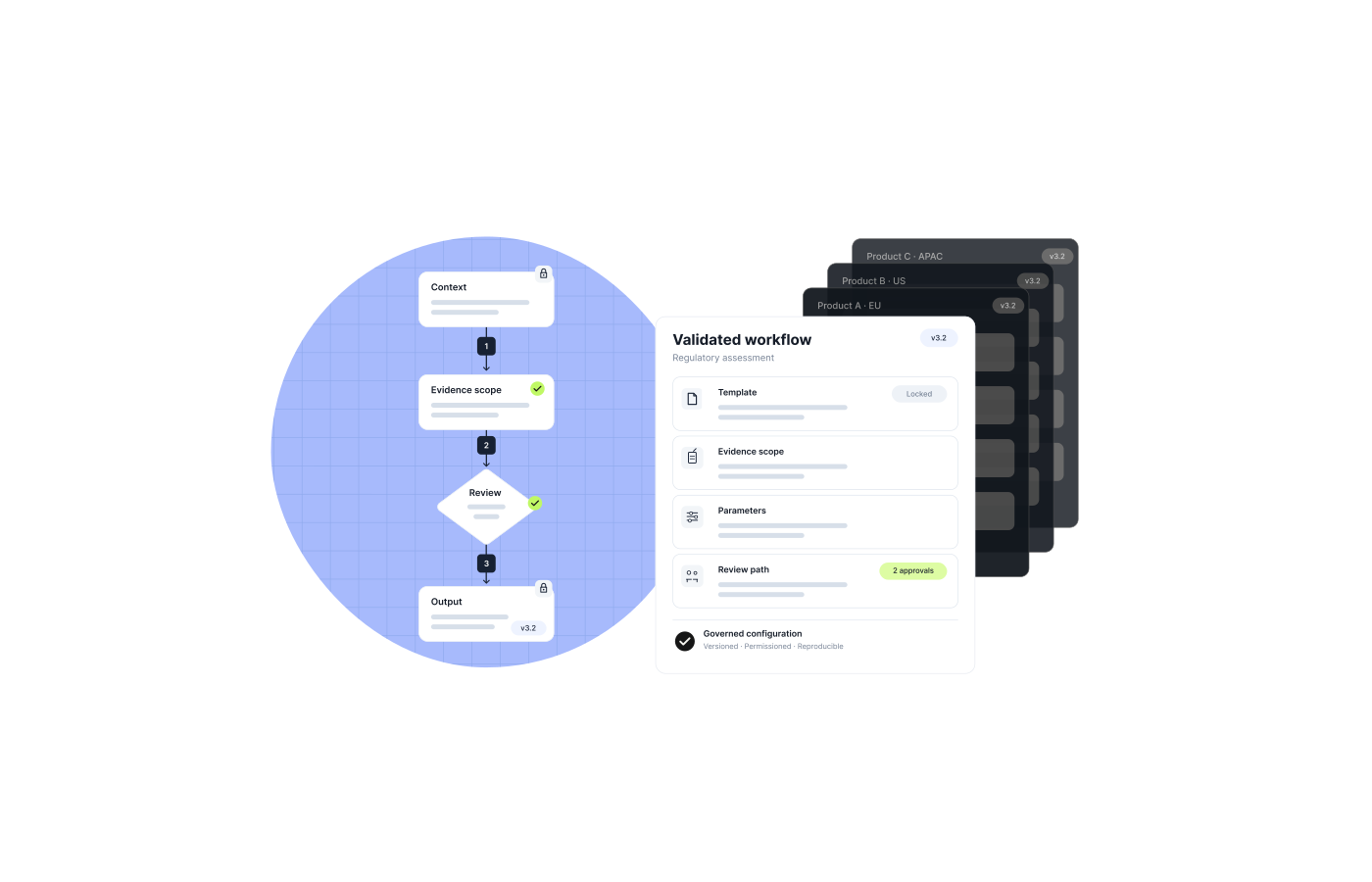
Versioned templates, controlled parameters, defined evidence scopes, permissions, and review paths enable teams to apply the same governed methodology across products, markets, and teams.

Each run preserves the inspectable artifacts required to reconstruct the work: inputs, sources, configurations, outputs, review actions, decisions, versions, and timestamps.

Subject-matter experts review, edit, approve, or reject AI-generated work at defined checkpoints, with clear attribution and accountability for each decision.


Review literature, answer medical questions, and map evidence gaps from a governed, source-linked knowledge base.
Tell us where evidence is slowing your team down. We’ll show you how Biolevate can turn it into a governed, source-linked workflow.
Copyright © Biolevate 2026
Copyright © Biolevate 2026
Copyright © Biolevate 2026
Copyright © Biolevate 2026